
Alfred’s Basic Piano Library: Level 1 ⏤ A Comprehensive Guide
Navigating the digital world, finding a legitimate Alfred’s Piano Book 1 PDF requires caution. Beware of phishing scams and prioritize legal access to learning materials.
What is Alfred’s Piano Book 1?
Alfred’s Basic Piano Library: Level 1 is a widely-used introductory piano method book, designed for beginners of all ages. It systematically introduces fundamental musical concepts, building a strong foundation in piano playing. The book focuses on developing reading skills, technique, and musicality through a progressive series of lessons and exercises. It’s a cornerstone for many aspiring pianists, offering a structured path to learning.
However, seeking a free PDF version online presents risks. Numerous websites offer downloads, but many are illegitimate, potentially containing malware or violating copyright laws. While samples are available legally, obtaining the entire book without purchase is generally unlawful. Users should exercise extreme caution and prioritize legitimate sources to avoid security threats and support the creators of this valuable resource.

The Importance of a Solid Foundation in Piano Learning
Establishing a strong foundation is paramount in piano learning, and Alfred’s Piano Book 1 excels at providing just that. Early lessons shape proper technique, hand position, and music reading skills – habits difficult to correct later. A rushed approach, perhaps fueled by seeking a quick free PDF download and skipping foundational exercises, can lead to long-term challenges.
Ignoring fundamentals hinders progress and can cause frustration. A solid base allows for smoother advancement, enabling students to tackle more complex pieces with confidence. While the allure of a free resource is understandable, prioritizing a structured, legitimate learning path – even if it requires investment – yields far greater and more lasting results. Building correctly from the start is key.
Understanding the Alfred’s Method Approach
Alfred’s Basic Piano Library employs a progressive, step-by-step approach, introducing concepts gradually. It balances familiar melodies with new theoretical elements, fostering engagement and comprehension. The method emphasizes a multi-faceted learning experience, integrating technique, theory, and performance. While searching for an Alfred’s Piano Book 1 PDF might seem efficient, it risks disrupting this carefully sequenced learning path.
The series prioritizes building a strong musical vocabulary and encourages students to apply learned concepts creatively. It’s designed for self-study, but benefits greatly from a teacher’s guidance. A fragmented learning experience, potentially resulting from an incomplete or unofficial PDF, can hinder the method’s effectiveness. Consistency and a structured approach are vital.
Finding Alfred’s Piano Book 1 PDF for Free (and Legally)
Locating a free, legal PDF of Alfred’s Piano Book 1 requires diligent searching. Explore official sources and library resources cautiously.
Legitimate Sources for Free PDF Samples
Accessing free samples of Alfred’s Basic Piano Library, Level 1, legally is possible through several avenues. Many online music retailers, like Amazon and Sheet Music Plus, often provide preview pages or downloadable sample PDFs to allow potential buyers to assess the content before purchasing the full book. These samples typically include a few introductory lessons, showcasing the method’s approach to music notation, rhythm, and basic piano techniques.
Alfred Music Publishing’s official website is another excellent starting point. While a complete free PDF is unlikely, they frequently offer supplementary materials, including sample exercises and lesson excerpts, that can provide a taste of the Level 1 curriculum. Be wary of unofficial websites claiming to offer full PDFs, as these often harbor malware or violate copyright laws. Prioritize reputable sources to ensure a safe and legal learning experience.
Exploring Online Music Libraries and Archives
While a complete, free PDF of Alfred’s Piano Book 1 is rarely found in online libraries, exploring these resources can yield related materials. The Internet Archive, a digital library offering archived websites, books, and music, might contain older editions or supplementary resources connected to the Alfred’s method. Similarly, university and public library digital collections sometimes include music education materials, though access often requires a library card.
Be cautious when navigating these archives. Copyright restrictions apply, and downloading copyrighted material without permission is illegal. Focus on searching for supplemental exercises, music theory guides, or public domain piano pieces that complement the Alfred’s curriculum. Remember that these libraries are more likely to host sheet music inspired by the method rather than the textbook itself.
Utilizing Library Resources for Access
Your local public library remains a valuable, legal resource for accessing Alfred’s Piano Book 1. Many libraries stock physical copies of the book, allowing for in-library study or borrowing. Furthermore, some libraries offer interlibrary loan services, enabling you to request the book from another library system if it’s unavailable locally.
Increasingly, libraries are expanding their digital offerings. Check if your library subscribes to online music learning platforms or provides access to digital sheet music databases. While a direct PDF of the textbook might not be available, these resources can supplement your learning. Don’t hesitate to ask a librarian for assistance; they can guide you to relevant materials and resources within the library’s collection.
Content Overview: What You’ll Learn in Level 1
Level 1 builds a foundation in music basics: notation, rhythm, hand position, simple melodies, and introductory key signatures like C and G Major.
Basic Music Notation: Treble and Bass Clef
Alfred’s Level 1 introduces the fundamental building blocks of reading music, starting with the treble and bass clefs. Students learn to identify notes on the staff, understanding how their position dictates pitch. The treble clef, often called the G clef, primarily represents higher-pitched notes played with the right hand. Conversely, the bass clef, or F clef, signifies lower-pitched notes typically played with the left hand.
The book systematically guides learners through note recognition, utilizing mnemonics and visual aids to solidify understanding. Students practice associating notes with their corresponding keys on the piano. This initial focus on clef reading is crucial, as it forms the basis for interpreting all subsequent musical instructions. Mastering these clefs unlocks the ability to decode written music and translate it into beautiful sounds.
Alfred’s Level 1 carefully introduces rhythm and time signatures, essential for playing music with accurate timing. Students begin with basic note values – whole, half, quarter, and eighth notes – learning to understand their relative durations. The concept of beats is established, and learners practice clapping and counting rhythms before applying them to the piano.
Time signatures, like 4/4, are explained as a framework for organizing beats within a measure. The top number indicates how many beats are in each measure, while the bottom number defines which note value receives one beat. Through simple exercises, students develop a strong sense of pulse and learn to maintain a steady tempo. This foundational rhythmic understanding is vital for musical expression and coordination.
Finger Numbers and Hand Position
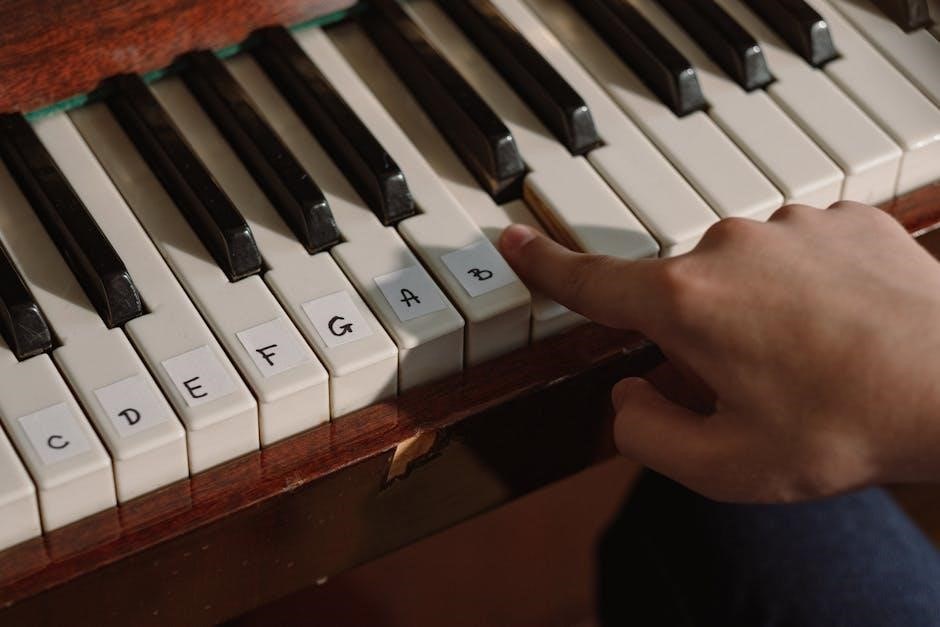
Alfred’s Level 1 emphasizes correct finger numbers and hand position from the outset, crucial for efficient and comfortable piano playing. Each finger is assigned a number (1-5), starting with the thumb as 1, to facilitate clear instruction and practice. Students learn to curve their fingers naturally, maintaining a relaxed wrist and forearm.
Proper hand position promotes good technique and prevents strain. The book guides learners to sit at the correct height and distance from the piano, ensuring a balanced posture. Exercises focus on developing finger independence and coordination, gradually introducing more complex movements. Consistent attention to these fundamentals builds a solid foundation for future musical development and avoids bad habits.
Playing Simple Melodies with Both Hands
Alfred’s Level 1 skillfully introduces playing melodies with both hands simultaneously, a significant milestone for beginner pianists. Initially, exercises focus on coordinating the right hand (typically playing the melody) with the left hand (providing a simple accompaniment, often single notes or chords). This builds essential coordination and independence.
The book presents carefully selected pieces designed for success, gradually increasing in complexity. Students learn to read notes in both clefs and translate them into accurate finger movements. Emphasis is placed on maintaining a steady rhythm and a balanced sound between both hands. Patience and consistent practice are key to mastering this skill, unlocking the joy of creating complete musical phrases.
Understanding Key Signatures (C Major, G Major)
Alfred’s Level 1 gently introduces the concept of key signatures, starting with C Major – which has no sharps or flats – providing a comfortable foundation. Students learn to identify notes on the staff and relate them to the piano keyboard within this key; The book then progresses to G Major, introducing the F# sharp, and explaining its impact on note reading.
Understanding key signatures is crucial for interpreting musical notation accurately. Alfred’s method emphasizes recognizing the pattern of sharps or flats at the beginning of the staff and applying that knowledge when reading the music. This builds a fundamental understanding of tonal relationships and prepares students for more complex keys later on.

Supplementary Resources to Enhance Learning
Beyond the book, explore Alfred’s website, YouTube tutorials, and interactive piano apps for practice. These tools reinforce concepts and make learning fun!
Alfred’s Website: Additional Materials and Support
Alfred Music’s official website serves as a central hub for supplementary resources designed to bolster your learning experience with Level 1. While a completely free PDF of the entire book is unlikely to be found legally, the website offers valuable downloadable materials, including practice tracks accompanying the pieces in the book. These audio files are crucial for developing rhythmic accuracy and understanding musical phrasing.
Furthermore, Alfred’s provides access to enhanced lesson plans for teachers, which can be beneficial even for self-learners seeking a structured approach. You’ll discover supplemental exercises, theory worksheets, and performance assessments. The site also features a FAQ section addressing common student difficulties and a contact form for direct support. Regularly checking the website for updates and new resources is highly recommended to maximize your progress with Alfred’s Basic Piano Library, Level 1.
YouTube Tutorials for Alfred’s Level 1
YouTube is a treasure trove of instructional videos specifically tailored to Alfred’s Basic Piano Library, Level 1. Numerous piano teachers and enthusiasts have created comprehensive walkthroughs of each lesson, offering visual demonstrations of proper hand position, fingering techniques, and rhythmic patterns. Searching for specific song titles or lesson numbers within the book will yield targeted tutorials.
These videos can be incredibly helpful for clarifying challenging concepts and observing how pieces should sound. Many tutorials also provide slow-motion playback and close-ups of the keyboard, aiding in accurate replication. However, remember that YouTube content varies in quality; prioritize channels with clear audio, well-lit visuals, and experienced instructors. Supplementing your study with these free resources can significantly enhance your understanding and accelerate your progress, even without a full PDF.
Online Piano Games and Apps for Practice
Gamified learning can transform piano practice from a chore into an engaging activity. Several online platforms and mobile applications offer interactive exercises designed to reinforce the concepts introduced in Alfred’s Basic Piano Library, Level 1. These tools often focus on note recognition, rhythm training, and hand coordination, providing immediate feedback on your performance.
Apps like Flowkey, Simply Piano, and Piano Maestro utilize game-like interfaces to motivate learners. While some require subscriptions, many offer free trial periods or limited access to beginner lessons. These resources can be particularly beneficial for developing a strong musical foundation, even if you’re accessing the book’s content through alternative means. Remember to prioritize consistent, short practice sessions over infrequent, lengthy ones for optimal results.
Sheet Music Websites Offering Beginner Pieces
Expanding beyond the Alfred’s Level 1 repertoire is crucial for musical growth. Numerous websites provide access to a vast library of beginner-friendly sheet music, often available for free or at a low cost. Websites like Musicnotes.com, Sheet Music Plus, and IMSLP (Petrucci Music Library) offer diverse selections, including public domain pieces and arrangements suitable for early-stage piano students.
Exploring these resources allows you to supplement your learning with pieces that align with your interests, fostering motivation and enjoyment. While searching, filter by difficulty level and instrument (piano) to streamline the process. Remember to always respect copyright laws and support composers and publishers when possible. Utilizing these platforms alongside your Alfred’s book can significantly enhance your musical journey.

Troubleshooting Common Issues with Alfred’s Book 1
Digital access can sometimes lead to formatting issues or incomplete PDFs. Ensure a reliable source and verify file integrity for optimal learning.
Difficulty with Rhythm and Counting
Rhythmic challenges are common for beginners, even with a legitimate Alfred’s Level 1 PDF. Many students struggle initially with accurately counting and maintaining a steady beat while playing. Utilizing a metronome is crucial; start slowly and gradually increase the tempo.
Online resources, including YouTube tutorials specifically for Alfred’s Book 1, often demonstrate rhythmic exercises. Breaking down complex rhythms into smaller, manageable parts can also be helpful. If the PDF lacks audio examples, seek them out online to hear the correct timing. Remember, consistent practice and focused attention on the beat are key to overcoming these difficulties. Don’t hesitate to seek guidance from a qualified piano teacher for personalized support.
Struggling with Hand Coordination
Developing hand coordination is a significant hurdle for many piano students, even when using a legally obtained Alfred’s Level 1 PDF. The brain needs time to learn to control both hands independently and simultaneously. Start with very slow practice, focusing on accuracy over speed.
Isolate sections where coordination is difficult and practice each hand separately before combining them. Online resources, including supplemental exercises found alongside the PDF, can help. Consider using online piano games designed to improve coordination. A teacher can provide tailored exercises and feedback. Patience is vital; consistent, deliberate practice will gradually build the necessary neural pathways for seamless hand coordination.

Understanding Music Theory Concepts
Alfred’s Level 1 introduces fundamental music theory, which can be challenging even with a legitimate PDF version. Concepts like note values, time signatures, and key signatures require dedicated study. Don’t simply memorize; strive to understand why these concepts exist and how they affect the sound.
Utilize supplementary resources – YouTube tutorials specifically addressing Alfred’s Book 1 often explain theory clearly. Online music theory websites offer interactive exercises. If the PDF lacks sufficient explanation, seek additional learning materials. A qualified teacher can provide personalized guidance and clarify confusing concepts, ensuring a solid theoretical foundation for future musical growth.
Finding a Qualified Piano Teacher
While a free Alfred’s Piano Book 1 PDF offers a starting point, a teacher provides invaluable personalized instruction. Self-teaching can lead to ingrained bad habits, hindering progress. Look for a teacher with experience using the Alfred’s method, ensuring they understand the curriculum’s progression.
Consider qualifications – a degree in music or certification from a recognized piano teaching organization are good indicators. A good teacher will assess your learning style, provide constructive feedback, and tailor lessons to your needs. They’ll also address challenges not covered in the book, fostering a deeper understanding and preventing frustration. Don’t underestimate the power of human guidance!
Alternatives to Alfred’s Piano Book 1
If a free PDF proves elusive, explore Faber, Hal Leonard, or Thompson’s methods. Each offers a unique approach to beginner piano instruction and learning;
Faber Piano Adventures: Level 1
Faber Piano Adventures presents a compelling alternative, often praised for its engaging approach and colorful illustrations, making it particularly appealing to younger learners. Unlike solely focusing on rote learning, Faber integrates music theory seamlessly with practical application, fostering a deeper understanding of musical concepts from the outset. While a completely free PDF of the entire book might be difficult to locate legally, Faber offers supplementary materials and demo tracks on their website.
Many online music stores provide sample pages or individual pieces for purchase, allowing potential users to assess the method’s suitability. It’s crucial to remember that supporting publishers through legitimate purchases ensures continued quality and innovation in music education. Exploring online piano communities and forums can also reveal shared resources and learning tips for Faber Piano Adventures Level 1.
Hal Leonard Student Piano Library: Book 1
Hal Leonard Student Piano Library distinguishes itself with a focus on popular and familiar melodies, aiming to motivate students through recognizable tunes. This approach can be particularly effective for those who respond well to contemporary music. While a full, free PDF download is unlikely to be found legally, Hal Leonard provides a wealth of supplementary resources, including audio tracks and practice materials, available for purchase on their website and through music retailers.
Similar to Faber and Alfred, seeking legitimate sources is vital. Many online sheet music platforms offer individual songs from the library, allowing a trial before committing to the full book. Remember, supporting copyright protects the creators and ensures continued development of quality piano learning resources. Online forums dedicated to piano learning often discuss this method and share helpful practice tips.
John Thompson’s Modern Course for the Piano ‒ First Grade
John Thompson’s Modern Course is a historically significant method, known for its systematic and thorough approach to piano technique and music theory. While a completely free PDF of the First Grade book is difficult to locate legally, numerous used copies are available for purchase online through platforms like eBay and Amazon. Be cautious of websites offering free downloads, as these often contain malware or violate copyright laws.
Thompson’s method emphasizes a strong foundation in reading music and developing proper hand position. Supplemental materials, including practice tracks and exercises, can be found through music retailers. Exploring online piano communities can provide valuable insights and support for learners using this classic method. Remember, prioritizing legal access ensures the continued availability of quality educational resources.

Copyright and Legal Considerations
Downloading unauthorized PDFs risks legal repercussions and undermines creators’ rights. Supporting publishers ensures continued access to quality music education materials for all learners.
The Risks of Downloading Illegal PDFs
Illegally obtaining Alfred’s Piano Book 1 PDF exposes users to significant risks. These downloads often harbor malware, viruses, and spyware, compromising your device’s security and personal data. Phishing scams, disguised as free PDF links, aim to steal sensitive information like login credentials and financial details – mirroring concerns raised about WhatsApp scams.
Furthermore, downloading copyrighted material without permission is a violation of intellectual property law, potentially leading to legal penalties. Supporting legitimate sources protects authors and publishers, ensuring the continued creation and availability of valuable educational resources. Prioritizing legal access, even through free samples or library resources, safeguards your digital wellbeing and upholds ethical practices within the music education community.
Supporting Music Publishers and Authors
Choosing legitimate avenues for accessing Alfred’s Piano Book 1 directly supports the creators and publishers who invest in quality music education materials. Their work fosters musical growth and deserves recognition. Purchasing the book, even a physical copy, or utilizing officially sanctioned digital platforms ensures they can continue developing innovative resources.
This contrasts sharply with the risks associated with illegal PDF downloads, which undermine their livelihood. Similar to concerns about platforms like Hifini music shutting down due to unforeseen circumstances, supporting publishers helps maintain a sustainable ecosystem for music education. By respecting copyright and opting for legal access, you contribute to a thriving community and ensure future generations benefit from these valuable resources.
Fair Use and Educational Purposes
While accessing Alfred’s Piano Book 1 PDF for free can be tempting, understanding “fair use” is crucial. Limited excerpts for educational review, like a teacher sharing a page for classroom instruction, may fall under fair use, but wholesale copying or distribution is illegal.
The situation mirrors concerns about accessing resources online, as seen with platforms facing shutdowns. Educational institutions often have licenses allowing controlled access to copyrighted materials. Individuals seeking to learn should prioritize purchasing the book or utilizing legitimate sample PDFs offered by Alfred or authorized retailers. Respecting copyright fosters a sustainable learning environment, avoiding the risks associated with unauthorized downloads and supporting the creators’ rights.